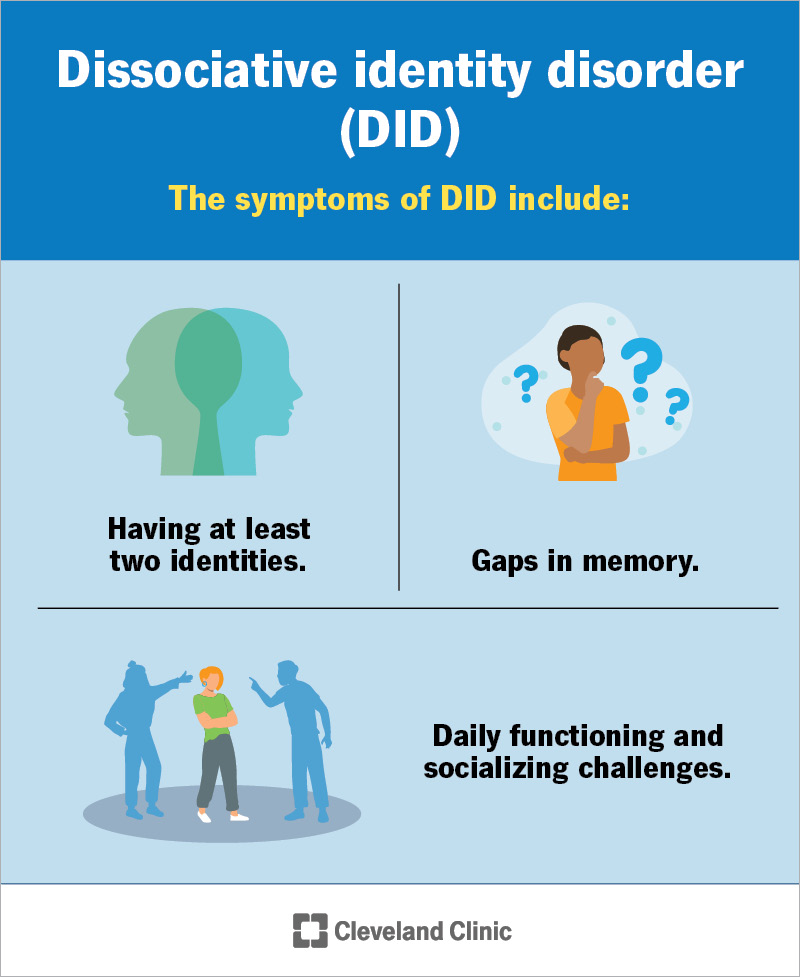
Dissociative identity disorder (DID) is a mental health condition where you have two or more separate personalities that control your behavior at different times. When personalities switch, you’ll have gaps in your memory. The identities are usually caused by living through trauma. DID can also technically be classified as a Personality Disorders.
“Dissociate” means to separate or disconnect. People with dissociative identity disorder may experience several different personalities, usually referred to as alters. Each identity may have different behaviors, memories, thought patterns or expressions. The identities might have different ethnicities and ways of interacting with their environments.
These personalities may control your behavior at different times. Memories may not transfer from one identity to another, which can cause amnesia. The presence of amnesia is often an important symptom that raises concern for the diagnosis.
DID interferes with your ability to function in your day to day. It can impact your relationships with others and performance at school or work.
Other mental health symptoms that can (but not always) be found along with DID include:
What are the types of dissociative identity disorder?
There are two types (or forms) of DID:
- Possession: Identities present as if an outside being or spirit took control of your body. You might speak or act differently in a way that’s obvious to others. It’s an unwanted identity and the personality switch is involuntary.
- Nonpossession: Identities are less known to others. You might feel a sudden change in your self-identification, as if you’re watching yourself in a movie (an “out-of-body” experience) instead of being in control of your speech, emotions or behaviors.
It’s important to note that possession is a common belief of different cultures and religions around the world, but these voluntary spiritual practices aren’t associated with DID.
How common is dissociative identity disorder?
DID isn’t common. One small U.S. study found that DID affects an estimated 1.5% of people.
Current estimates on how common this condition is may vary based on new diagnostic criteria introduced in the Diagnostic and Statistical Manual of Mental Disorders, 5th Edition (DSM-5).