Alzheimer’s disease (AD) is the most common cause of Dementia. Alzheimer’s is pronounced “alz-HAI-mers.” It’s a neurodegenerative disease that affects your brain. This means it damages and destroys cells in your brain over time. Eventually, people with AD lose some of their brain functions, including memory and language.
Alzheimer’s disease affects approximately 24 million people worldwide. One in 10 people older than 65 have it. Nearly 1 in 3 people older than 85 have AD.
Healthcare providers can suggest treatments to manage symptoms, but there’s no cure for Alzheimer’s disease. Talk to a provider if you’re worried you or a loved one have AD symptoms.
Signs and Symptoms
Talk to a healthcare provider if you’re worried you or a loved one have Alzheimer’s disease symptoms.
What are Alzheimer’s disease symptoms?
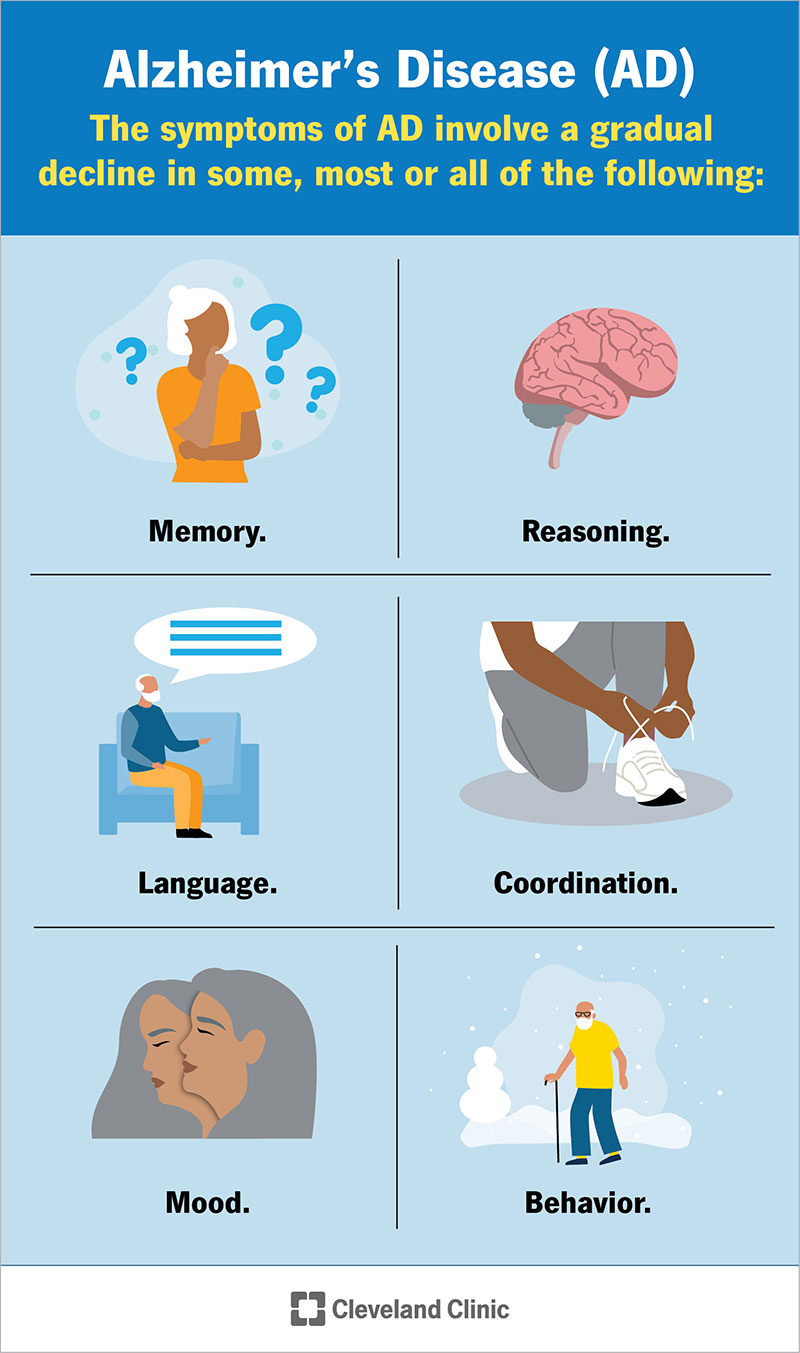
Alzheimer’s disease affects everyone differently. But in general, it can weaken or completely eliminate your:
- Memory
- Reasoning
- Language
- Behavior and personality
- Spatial understanding
People with memory loss or other Alzheimer’s symptoms may have difficulty recognizing changes in their own mind and body. These signs may be more obvious to loved ones.
Symptoms will get noticeably worse over time (a progressive decline). See a healthcare provider right away if you or a loved one have any dementia-like symptoms.
Memory
Memory loss is the most common Alzheimer’s symptom. It can affect your ability to recall recent events (short-term memory) or things that happened a long time ago (long-term memory).
You may have trouble remembering:
- Faces or names
- Facts
- Where you are (even in familiar places like at home)
Memory issues from AD are different and more serious than occasionally forgetting where you left your phone or wondering if you locked the door when you came home.
Reasoning
Someone with Alzheimer’s might seem confused or like they’re taking an unusually long time to make a choice or decision. This can affect your ability to:
- Decide what to do next
- Follow a recipe
- Make plans
Language
Alzheimer’s disease can make it hard for you to speak, read or understand language (aphasia). You may:
- Communicate or talk less than you used to
- Mix-and-match languages (if you speak more than one)
- Revert to speaking in the language you spoke most when you were growing up
- Say or use the wrong word
Behavior and personality
You might notice mood or personality changes in a person with Alzheimer’s disease. They might:
- Act more suspicious (even around people they’ve known for years)
- Experience mood swings (including being more aggressive than usual)
- Feel increased agitation, paranoia or hallucinations
- Strop trusting themselves or loved ones
Everyone has a bad day or feels upset sometimes. But mood and personality changes caused by Alzheimer’s are more intense or sudden than everyday anger or grumpiness.
Spatial understanding
You may have a hard time understanding how close objects around you are from your body or feel less coordinated than usual. This can include:
- Bumping into furniture
- Having a tough time picking something up
- Struggling to do delicate hand motions (like tie your shoes or type on a keyboard)
Experts classify Alzheimer’s disease with stages. These stages can refer to how close you are to having dementia, the Alzheimer’s severity or how quickly it developed.
Causes
What causes Alzheimer’s disease?
An abnormal build-up of proteins in your brain causes Alzheimer’s disease. Specifically, two proteins called amyloid and tau.
Your brain has billions of nerve cells called neurons. Your neurons let you think, learn, remember and plan. Amyloid protein sticks together in your brain cells, forming clumps called plaques. Tau proteins twist together in fiber-like strands called tangles. The plaques and tangles prevent neurons from working as they should. They block neurons’ ability to send electrical and chemical signals back and forth.
When amyloid and tau proteins build up in your brain, they slowly kill neurons. This causes permanent damage that leads to Alzheimer’s symptoms. Nerve cell death starts in one area of your brain and then spreads to other areas. It’s most common for Alzheimer’s to begin in the area of your brain that controls memory — your hippocampus.
Experts are still studying Alzheimer’s disease to learn more about what exactly causes these proteins to build up. Researchers think the protein build-up happens a long time before it causes symptoms. It might happen up to 10 years before you notice any changes.
Is Alzheimer’s disease hereditary?
Yes, Alzheimer’s can be hereditary (genetic).
Your risk of developing Alzheimer’s disease is 10% to 30% higher if you have a biological parent or sibling with it. You’re three times more likely than average to develop AD if two or more of your biological siblings have it.
Having the APOE ε4 gene increases your risk of developing Alzheimer’s. It’s also associated with developing AD at a younger age (an earlier age of onset). But not everyone who has the APOE ε4 gene will get Alzheimer’s. It’s just one factor that can increase your risk.
What are Alzheimer’s risk factors?
Researchers don’t know why some people get Alzheimer’s disease and others don’t. Some risk factors may include:
- Being Black or Latino
- Environmental factors (something about where you live, work or spend a lot of time)
- Genetic changes
- Having a traumatic brain injury
- Smoking
- Your age (AD usually affects people older than 65)
- Your overall health
Some health conditions may increase your Alzheimer’s risk, including:
- Cardiovascular disease
- Diabetes
- Down syndrome caused by trisomy 21
- High blood pressure
- High cholesterol
- Obesity
What are the complications of Alzheimer’s disease?
The biggest complication of Alzheimer’s disease is the damage it does to your brain. That can cause permanent changes to your ability to think, to use your body and to your personality. As the condition progresses, you’re likely to experience complications, some of which can be fatal.
Complications can include:
- An overall decline in physical health
- Infections (like pneumonia or skin infections)
- Seizures
- Trouble breathing
- Trouble swallowing
You may lose your ability to control your body. This can increase your risk of:
- Bedsores
- Dehydration or malnutrition
- Falls, bone fractures and other traumatic injuries
- Losing control of your pee (urinary incontinence) and poop (bowel incontinence)
- Tooth decay, cavities and other dental issues